Archeological sites
Siracusa
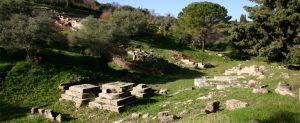
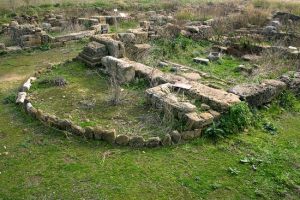
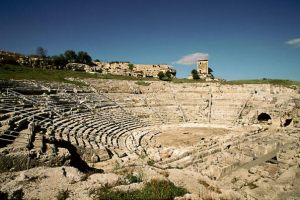
Parco della Neapolis, Syracuse: a site of inestimable archaeological value, it is located in the part of the city that rises on the mainland. It was built between 1952 and 1955 at the behest of the archaeologist Luigi Bernabò Brea, then Superintendent for Cultural Heritage of Eastern Sicily, with the aim of enclosing in a single protected site all the monuments that were in that area and thus shelter them from the strong urban expansion of those years. In the park are most of the remains of the Greek and Roman cities. First of all the Greek Theater, a spectacular building largely excavated in the limestone rock, already known in antiquity and used, among others, by Aeschylus. The Ara of Ierone, built by Gelone in the III century a.C .: an enormous sacrificial altar dedicated to Zeus and of which the base remains today. The Roman amphitheater of the II / III century BC, dug into the limestone rock, was brought to light in 1839 by the Duke of Serradifalco.
The building, with monumental dimensions, has two entrances and is served by a complex system of stairs. The arena was equipped, in the middle, with a large rectangular room that, through an underground passage, allowed the movement of the complex machinery used during the shows. The corridor around the cavea, whose first steps were reserved for the personages of rank, allowed the entrance to the arena of gladiators and beasts. In the highest part of the Temenite hill, there is the Cave of the Nymphaeum, an artificial cavity carved into the rock. At its entrance were placed statues dedicated to the Muses while the fountain is inspired by the Greek cult of the nymphs, deities of nature: from them comes the name of Nymphaeum. The Nymphaeum of Syracuse is thought to be the ancient seat of Mouseion (the Shrine of the Muses), the seat of the artists’ guild, the place where the Syracusan actors met before the shows. Near the Greek Theater we find the very famous Ear of Dionysus which allows a natural amplification of the sounds. It is one of the most characteristic and visited places in the city. Other areas of interest located within the Park are the triumphal Arch of Augustus, the evocative Via dei Sepolcri, flanked along all the way from votive shrines dedicated to the cult of the Heroes, the Galermi Aqueduct and the relative Mills of which only the “Casetta dei Mugnai”. The archaeological sites branch off in all directions: from the Syracuse Forum to the Roman Gymnasium; from the rocky terrace of Scala Greca to the Greek roads and the coastal latomie. Of particular interest is the Temple of Olympian Zeus built in the early decades of the sixth century BC. about three kilometers from the town. It is the second oldest temple in Syracuse after that of Apollo in Ortigia. We end our review with the Eurialo Castle, located about seven kilometers away from the city, near the hamlet of Belvedere. The castle, built by Dionysus between 402 and 397 BC, is a great work of military engineering. The entrance is protected by three ditches plus a lateral one and the whole building has several very ingenious strategic elements (tunnels, blind spots, side towers, partition walls) that were used to catch any assailants by surprise. We want to complete our review by reporting Stentinello, a Neolithic village located north of the city.
Megara Hyblea, Augusta: it is an ancient Hellenistic settlement, discovered in 1867 during the construction of the railway. During the 19th century, French archaeologists Gerorges Vallet and François Villard, together with the Italians Luigi Bernabò Brera and Gino Vinicio Gentili, brought to light a town and a necropolis; the latter in 1949 was partially covered due to the construction of a refinery. During the ’50s, targeted interventions by the superintendent for cultural heritage, allowed the rescue of numerous artifacts and part of the complex inside the walls of the Greek city. From this site come numerous relics of inestimable value such as the statue of Kourotrophos; still visible parts of the walls, the agora with the remains of two porticoes, the Hellenistic temple, the foundations of an archaic temple, the prytaneum, some workshops and houses.
Masseria Campolato, Augusta fraz. Brucoli: prehistoric settlement located on the cliff of Capo Campolato Basso; the excavations have brought to light overlapping settlements and numerous ruins testify to frequentation also in the Hellenistic and Roman periods. Cave of the Madonna dell’Adonai, Augusta fraz. Brucoli: archaeological area located at the Bay of Silence. It is a very extensive and very ancient rock necropolis; the Hermitage of Adonai is part of it, even if after the foundation.
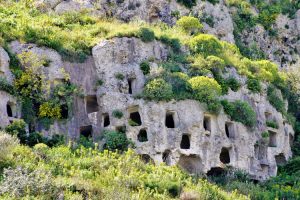
The nature reserve oriented Cavagrande del Cassibile, Avola – Noto – Syracuse: it is home to limestone caves, the so-called cave tombs, carved into the rock face for funeral purposes. The site has been a nature reserve since 1984. The Siculi, the first inhabitants of the place, built a necropolis here, still difficult to reach today. On the north side it is possible to observe a small group of cave dwellings, commonly known as the Grotta dei Briganti. In the southern area there is a complex system of dwellings, dug into the rock, arranged side by side on six different parallel levels, connected to each other by a system of tunnels and tunnels. On the edge of the reserve, to the north-east, there are several ancient necropolis, rich in tomb goods and ceramic material: the peculiar decoration, called plumed or marbled, is part of the Ausonia culture present in the Aeolian Islands and in eastern Sicily around 1000 B.C
Castelluccio di Noto, Noto: just outside the city, located in the northern part of the territory, the archaeological site has a sort of fortified acropolis and a necropolis with over 200 artificial caves, excavated in the steep walls of the nearby Lady’s quarry. The most monumental is the so-called Tomba del Principe with a façade consisting of four false pillars. In the same area, a Sicilian necropolis of the VIII / VII century BC was identified. Worthy of note, Noto antica, on the Alveria hill, about ten kilometers from the town, preserves the remains of different historical periods: the Aragonese castle and the Byzantine catacombs of the VI / VII century, as well as a tomb dating back to classical Greece , remains of the sixteenth-century city as well as of the Hellenistic period.
Nature reserve oriented Oasi di Vendicari, Noto: in addition to being an area of naturalistic interest, the reserve is home to archaeological remains, including tanks-deposit of an ancient factory for processing fish from the Hellenistic age, a small necropolis of the Byzantine era, the Sveva Tower, probably built by Pietro d’Aragona, the tuna of Vendicari, built in the eighteenth century, ceased its activity in 1943, today it is a building in decline that keeps the chimney in good condition, various factories and houses of fishermen .
Roman Villa del Tellaro, Noto: near the river of the same name, it has restored splendid mosaics representing, among other things, various hunting and convivial scenes. On March 15, 2008, over thirty years after the excavations, the villa was finally inaugurated and made accessible to the public. Also interesting is the archaeological area of Eloro, dating back to the eighth century BC, which remains among other things a temple dedicated to Demeter and Kore, a sanatorium consecrated to the god Aesculapius and a Greek theater. Finally, we point out the area of Monte Finocchito, not recognized as an archaeological park, halfway between Noto and Testa dell’Acqua. It is characterized by a grotticella necropolis dating back to 600 BC. and, at the summit, from the remains of an ancient Sicilian village, probably contemporary to Hybla, of which only the bases of massive fortifications and ancient carriages remain.
Avola Antica, Avola: is the site where the ancient settlement was built and then destroyed in 1693. It still preserves the ruins of the time. It was dominated by a castle with two towers that allowed control over Cassibile and Capo Passero. Around the castle developed the town with prestigious civil buildings and beautiful churches. Crossing the old inhabited center it is still possible to admire the remains of the ancient rock settlements, integrated then in the medieval inhabited center. Other discoveries in the municipal area are the Dolmen Ciancio and the Roman villa. The Dolmen was discovered in 1961 by Professor Salvatore Ciancio, along the Avolese coast, in the Borgellusa district. The structure is classic and raw, with a cross table supported by two pillars that have human interventions, floor and architrave instead maintain a rather uncertain and rough structure. Dating from the Neolithic period, it was a rock burial place (dug into the rock). It represents a unique example in Sicilian history. The Roman villa is located on the Tremoli seafront, in Marina di Avola. These are the burial remains of an ancient Roman villa dating back to the 2nd century BC The excavation operations that have been carried out in these places over the years have allowed us to find a great quantity of finds of extreme historical and archaeological value. Mosaics, pottery, coins and votive statues, preserved in the Civic Museum, have also allowed us to trace the causes of the ruin of the building, most likely a great fire.
Rock site of the Croci, Buccheri: it is immersed in the wooded area that surrounds Mount Tereo; on the site it is possible to visit the cave of San Nicola, a rupestrian church of the early Christian era.
Rock Church of St. Peter, Buscemi: site of great panoramic and landscape impact, mainly consisting of a sacred building dating back to the Byzantine era; it is located outside the town of Buscemi, in the area where the ancient Greek settlement once stood, then definitively destroyed by the Arabs. It has a rectangular shape with large rocky pillars, decorated with capitals. The altar is placed on a side part, raised, dug into the living rock. During the nineteenth century, numerous scholars found remains of frescoes of San Marco and Santa Sofia, dating back to early Christianity, of incommensurable historical, archaeological and artistic value. Outside the church there is a small sepulchral complex with rock tombs. Masella Cave and Sicula Necropolis of Contrada Maiorana, Buscemi: the enchanting Bosco di Monte Pavone nature area in the Maiorana district is home to an archaeological site of great interest. It is a complex dating back to the Neolithic period, studied by the famous archaeologist Luigi Bernabò Brera, consists of a settlement in the form of a village and a rock necropolis. Masotta Cave is part of the funerary complex, a large natural cavity, used for sepulchral purposes judging by the discovery of objects in terracotta and bone. Kasmenai, Buscemi: it is located on Monte Casale and it is an ancient Hellenic-Syracusan settlement, strategic for the control of the territory north of Palazzolo Acreide; used as a military outpost on the road that led to Selinunte in the early ‘900 was discovered and studied by the famous archaeologist Paolo Orsi.
The most interesting archaeological sites are Cozzo Guardiole, Petracca, Contrada Bagni, Cava Cardinale and Stallaini. At these sites, it is possible to admire the numerous paleocristian Canicattinese necropolis. Worthy of mention, the rock churches of San Marco, Cave of the Saints of Petracca, Santa Maria ad Alfano; important for the study of Sicilian Prehistory, the excavations conducted by Santo Tiné in the Grotta del Conzo and in the Grotta Chiusazza.
La Casa dello Scirocco, Carlentini: dates back to Roman times and is a building set in a large cave, located not far from the historic center. In the eighteenth century, at the time of the Corbino baronial family, it was a place of amorous conferences, before being abandoned for their own sake. In the eighties of the twentieth century the house was restored and bound by the Superintendence for Cultural Heritage for the architectural peculiarities of the building that boasts, in addition to the spa, a water circulation system designed to cope with the summer heat and keep cool.
Leontinoi Archaeological Park, Carlentini: ancient Hellenic city that extends over the Metapiccola Hill; the complex includes a monumental necropolis, located south of the site, and part of the city ruins including the so-called Porta Siracusana. Other ruins are visible near the neighboring Valle di Sant’Eligio where a large Necropolis is located. In the area of Valle Ruccia under Carlentini and the area of Colle Ciricò, other ruins can be traced, mostly rural settlements and terracing.
Rock Necropolis of Pantalica, Cassaro – Ferla – Sortino: it is an archaeological area inside the nature reserve; a context of rare beauty, famous in the world. On the plateau, between canyons formed over millennia by the tireless work of the rivers Anapo and Calcinara that flow modeling the landscape, among secular woods and enchanting valleys, stands the site of Pantalica. Nature is the setting for a rock necropolis of enormous historical and ethno-anthropological importance, included by UNESCO among the world heritage sites, in 2005. It is a much larger and more complex archaeological complex than one might think first impact. In fact, it consists of a group of necropolis: that of Filiporto, which has about a thousand tombs located on the basin of the Anapo; the necropolis of San Martino, composed of two archaic Tholos tombs, IV – V century AD .; the Byzantine catacombs, the Hypogeum of Dionysius and La Grotta di Sant’Anna, dating back to the 11th-13th centuries; the necropolis of North-West, the most ancient, of prehistoric times (XII-XI century a.C.); the Cavetta necropolis; the northern necropolis, the most extensive. On one of the highest points of the area, there are the remains of an ancient acropolis, extended over the centuries by Byzantine settlements dating back to the period of troglodyte following the invasions of the classical age. Case Giarranauti is an archaeological and naturalistic area, in the Giarranauti district, which is part of the larger Pantalica park. The archaeological part includes rural settlements from the late Roman and Byzantine periods. The findings are of great historical importance and confirm that these villages were populated until the arrival of the Arabs, then the rural village was inhabited until the earthquake of 1693.
Cava Spampinato, Floridia: is a large karst cavity, located in the Monastrello district, is rich in archaeological finds, starting from rock necropolis from the Sicilian era up to include some Byzantine catacombs. The history of these places is linked to the conflicts between the Greeks and the Syracusans, since the Battle of the Rupe Acrea took place here with the aggression by the aretusaeans of the Greek settlement on the hill. The testimonies are manifold, first of all the ruins of the inhabited center; then the Romans and then the Byzantines settled in these valleys, so rich in water and vegetation. Archaeological site of Tabaccheddu, Floridia: discovered by the archaeologist Paolo Orsi in the early twentieth century, it is made up of tombs carved into the limestone showing the entrance to the cockpit, that is from above; they returned important materials including a clay vase referable to the third Mycenaean period, between 1200 and 1100 BC, as well as various Sicilian finds. Scavi di Contrada Vignalonga and Monasteri, Floridia: in these areas there are very ancient finds, identified in settlements of the Sicilian era; many ruins from the Roman era, such as the patrician villas, the temples, as well as the magnificent statue of the Bacchus Inghirlandato, the pillars of Contrada Monasteri; the findings of the Byzantine Christian era, of the IV century AD, are sacred sites that can still be visited today.
Monte Roccarazzo Necropolis, Francofonte: the site retains its original structure only in the central part because it has been damaged over time by the overhanging quarry and by the leveling for agricultural cultivation. The necropolis housed about thirty tombs, mainly in the oven. Among the structures that were destroyed, the studies show a tholos, with a large ring vault and a deposit of lithic material. In the municipal area of Francofonte there is also the Contrada Passanatello Necropolis dating back to the Bronze Age. It was the object of study of the archaeologist Luigi Bernabò Brea, a great scholar of classical Sicilian archeology.
Prehistoric village Valsavoia and prehistoric village Castellana, Lentini: in the Valsavoia site there are circular huts of the Castellucian period and a necropolis with artificial caves; the prehistoric village Castellana, is a settlement dating back to the Neolithic age located south-west of Lentini. Also interesting is the Sant’Eligio necropolis which preserves the remains of oven-shaped tombs dating back to 700 BC.
Valle del Marcellino, Melilli: located in the hamlet of Villasmundo, inside it have been found important archaeological remains of prehistoric and pre-Greek age. The excavations in the valley proved to be of extraordinary importance because they allowed the dating of the trade relations between the Greeks and the Sicilian populations to be moved in more ancient times than those established in previous discoveries. In the area of Melilli interesting is the Cave of Mastro Pietro that opens at the foot of a paleo crag 200,000 years ago. Legend has it that a multitude of tunnels and rooms would develop in its subsoil. Inside it contains the tombs of the Bronze Age, stalactites and stalagmites. Even today it represents an important phenomenon of active karst.
Grotta Corruggi, Pachino – Portopalo di Capo Passero: it is a small cave located in the cliff to the left of the Contrada Vulpiglia beach, between the territories of Marzamemi and Portopalo di Capo Passero. It is one of the most important Sicilian Neolithic archaeological sites because it is located a few meters from the sea. It was studied by archaeologists Von Audrien, Paolo Orsi and Bernabò Brea. Many Neolithic finds were found, including tools (such as stone or bone spearheads and metal blades), bone remains of a specimen of “Equus Hydruntinus”, an animal similar to the donkey, extinct millions of years ago. Inside the Grotto of Calafarina, at the beginning of the twentieth century, the archaeologist Paolo Orsi discovered remains of various eras, especially the early Bronze Age. Some scientists believe that this cave has housed more than one family, given the large number of finds found including stone, bone and metal utensils, human remains and animals. It is part of the so-called “Archaeological Park of the Cugni di Pachino” also including the necropolis and the remains of Neolithic rock villages near the Contrada Calafarina. Recently it passed, with regional decree, to the property of the Superintendency of Syracuse.
Antica Akrai, Palazzolo Acreide: the archaeological site is located above today’s town and includes the Greek theater, presumably from the III century BC .; the bouleuterion, or the building dedicated to the meetings of the Senate; the temple of Aphrodite, of which today only the base remains; the Latomie, stone quarries used as necropolis during the early Christian period and place of detention of the Athenians defeated by the Syracusans during the expedition to Sicily during the Peloponnesian war (431-404 BC). The Santoni rock site, located on the road to Noto, consists of a group of twelve female figures carved in stone. It is the most important place of worship in Europe dedicated to Cybele, goddess of the fertility of the ancient Eastern world. The cult, originally from Anatolia, spread to the area presumably by the Corinthians who arrived in Syracuse, established it at the sub-colony of Akrai. Some put forward the hypothesis that the twelve reliefs of the divinity were not simply votive shrines, but rather a sort of stations functional to the performance of a particular sacred rite. In the area of Pachino, we point out the Grotta di Senebardo, a cave modeled in the Byzantine era to house one of the most important rock catacombs in the Aretusa area. Characteristics, the arcosolium niches located near the entrance to the cave. Inside there is an artificial skylight, on the sides of which are visible tombs carved into the rock. The interior of the catacomb shows inscriptions in ancient Greek
Thapsos archaeological site, Priolo Gargallo – Augusta: it is one of the most important Sicilian sites of the middle Bronze Age. The necropolis and the remains of the protohistoric settlement are located on the peninsula of Magnisi, the ancient Thapsos, remembered by the Athenian historian Tucidide (5th century BC) as the place where the Athenians camped in sight of the siege of Syracuse. The archaeological research begun in 1880 by the archaeologist Saverio Cavallari and continued with the studies of Paolo Orsi, Giuseppe Voza and Luigi Bernabò Brea, brought to light a vast settlement that remained uninterrupted in life from the fifteenth to the ninth century BC. The site presents such peculiar aspects as to have led scholars to talk about a real “Thapsos culture”, following the culture of Castelluccio but contemporary with that of the north-eastern area of Sicily, Milazzo and the Aeolian Islands. The location, ideal as a landing from the sea, immediately became an important commercial center of the Mediterranean, as evidenced by the findings of objects from Cyprus and Malta. The necropolises are located both along the northern coast and in the inner part of the peninsula. The tombs are of the oven type, dug into the rocky floor, with front access and being family tombs, contained numerous burials accompanied by rich outfits, now exposed to the Regional Archaeological Museum Paolo Orsi of Syracuse.
Archaeological Park of Cava Lazzaro, Rosolini: the most important archaeological area of the territory of Rosolini for the maximum concentration of archaeological sites therein. The quarry, which was born in the territory of Modica and precisely in the district of Gorgodaino, takes its name from a vast cavity present inside it and called precisely Grotta Lazzaro or Cava Grande di Rosolini. The quarry was inhabited already in prehistoric times and in the Bronze Age, in the era of the so-called Castelluccio culture. Evidence of the early Christian and Byzantine era would testify that it was inhabited continuously over time. The quarry is rich in karstic caves and artificial caves dug into the rock that were used as necropolis. Most of the archaeological finds found in the quarry area are now preserved in the Paolo Orsi Archaeological Museum in Syracuse. In the heart of Cava Lazzaro is the Hermitage of Croce Santa, one of the most interesting rock complexes of the Byzantine era of south-eastern Sicily.
Cozzo Collura, Solarino: is an archaeological area that is located a few kilometers from the town. The findings found following the excavations, refer to two historical periods or the IV-III century. B.C. and II-IV d.C. Among the most important findings, brought to light by the excavations of the seventies, are: the coins of the fourth century; a skeleton; many fragments of black-painted pottery; a statuette datable around the IV-III sec a.C. In the area you can also visit three noteworthy ruins, namely the Grotta di San Paolo, the Pozzo di San Paolo and the Church of San Paolo built in the early Christian age, almost entirely destroyed by the earthquake of 1693. Only the original construction remains today. the floor and the base of the walls to the north and west. Studies show that under the floor there was a structure destined for a burial grave.
Cava del Rivettazzo, Solarino: the name derives from the presence in the area of many brambles, it is a quarry formed following the erosion caused by the waters of the Anapo River that have carved a natural canyon. It houses a necropolis consisting of hundreds of tombs dating back to the Bronze Age and frequented for several centuries, as evidenced by the findings belonging to all three periods of the Bronze Age.