Towers and Castles
Siracusa
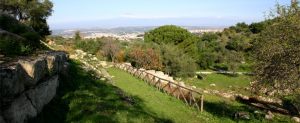
Castello Maniace, Syracuse: the castle concludes Ortigia to the south, was built by Frederick II of Swabia in the thirteenth century and became the headquarters of the Camera Reginale. The architecture of the square-shaped building with cylindrical towers, not very functional to military strategy, makes it difficult to place the impressive castle from the point of view of its use. Noteworthy in Ortigia are the only vestiges of the medieval walls, that is the Porta Marina, located in the north-west area of the island.
Castello Svevo, Augusta: it was built by Frederick II of Swabia in the 13th century on a former Norman watchtower. The military complex consists of a square wall surrounded by four corner towers and four in the middle of each side.
Forts Garsia and Vittoria, Augusta: take the name from the Viceroy Garçia de Toledo who wanted its construction in 1567. Built in the aftermath of the return of Augusta in the royal domain, they belong to the ensemble of fortifications created during the Turkish raids. Massive and imposing, they rise on two cliffs, connected by a thin strip of land.
Buccheri Castle, Buccheri: it was one of the most imposing fortresses in Sicily. It has a square perimeter, with two towers in the front and one, larger, in the center. Located on the top of the Tereo hill, it was home to the Alaimo, Macalda di Lentini and the Montalto family. Although they remain only ruins, it is possible to understand the strategic importance it has over the centuries. Inhabited between 1200 and 1300, it was at the center of numerous war events, among which we remember the struggles against the Angevins and civil wars between baronates. It collapsed in 1693 following the great earthquake that destroyed the whole Val di Noto and many of its stones were used by the inhabitants of the place for the reconstruction of the village. To date, as in past centuries, from the ruins of the fortress you can enjoy a breathtaking view that goes from the Gulf of Catania to central Sicily.
Ruins of the Castle of Requiesenz, Buscemi: a first fort was built by the Arabs who erected it, on the hill called Monte, after the foundation of the first inhabited center of Abu Xamah. The Normans destroyed it and built the castle on the ruins, then destroyed by the earthquake of 1693. Today you can visit the remains of the fortification that nevertheless give back an idea of the prestige of the past.
Ancient Cassaro and ruins of the castle, Cassaro: in the southern part of the town there is the archaeological area where the ancient town stood, on the Cugno Mirio, in a highly strategic position. Immersed in dense vegetation and not easily accessible, it preserves the ruins of the castle and the ancient Arab fortress, then enlarged by the Normans, which was destroyed by the earthquake of 1693.
Palazzo Gravina Cruyllas, Francofonte: the city center, perched on a hill around the oldest buildings, is considered one of the most beautiful in Eastern Sicily, with buildings rather interesting from an architectural point of view, thanks to the restoration of medieval buildings made in 1700 in Baroque style. Palazzo Gravina Cruyllas was rebuilt in 1705 (and completed in 1710), after the earthquake of 1693, at the behest of Don Sebastiano Gravina on the ruins of the ancient castle of Alagona, originally conceived, around 1300, as a defensive structure. It is one of the most beautiful structures of the eighteenth century in Sicily, although it still has some parts of medieval dating. In the nineteenth century the balustrades of the balconies were replaced with iron railings and the lower openings, which served as windows, were turned into entry gates. The only opening of the original project remained intact is that on the left side of the structure. The medieval castle also had three central towers, to which eight others were added later, four on each side, but the seismic event destroyed the entire building with the exception of a few small parts of the central towers. Castle of Chadra, Francofonte: also known as the Castle of Gadera, is a ruin of uncertain origins, probably referable to the period of war between the Angevins and the Aragonese. Structurally it is a baglio that rises on a promontory created by a bend of the Canale stream. It consists of a main tower, a rectangular courtyard of irregular shape and two parallel ditches with defense function: of the latter, the inner one has a depth of about four meters while the outermost has never been completed, presenting itself currently buried. Today only a few pieces of the master tower remain: from the historical documents it is clear that it had a cylindrical shape and overlooked directly on the baglio, presenting three floors and a crenellated terrace for a total height of about 20 meters. Ossena Castle, Francofonte: datable around 1300, its remains are located on a promontory furrowed by the river Ossena. It was built for the purpose of defending the underlying settlement, of Arab-Norman origin, whose existence today are witness to the caves carved into the rock. Among these the most interesting is the Grotta dell’Oratorio, inside which there are some remains of frescoes.
Castellaccio or Castrum Vetus, Lentini: the ruins of the medieval castle of Lentini, are located in an area not far from the town, in a strategic position for access to the plain of Catania. The building has the shape of a limestone cliff from the flat summit, located at the center of a fortified system that includes the Tyrone hill to the north-west and the Lastrichello hill to the south-east, from which it is separated by two deep ditches. A wall, probably, ran along the edges of the plateau forming a rough parallelepiped to the whole of which the military circles insisted. Only in recent times has been identified the entrance to the basement of the castle and a semicircular structure, probably the chapel of a building. The fortress, dating from the twelfth century, was renovated during the first half of the thirteenth century by the will of Frederick II. Between the end of the XIII and the beginning of the XIV century, it came to occupy a fundamental role for the survival of some of the most illustrious and noble Sicilian families. In 1434, Alfonso of Aragon assigned the castle to Vincenzo Gargallo. The building suffered serious damage as a result of the earthquakes of 1542 and 1693, when it was probably abandoned altogether. In 1986 the undergrounds were restored but much remains to be done to enhance the important building.
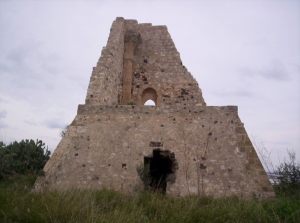
Torre Scibini, Pachino: this is the most important medieval archaeological monument of the Pachino municipal area, located between Pachino – Maucini – Portopalo. The tower was built around 1493 by order of Antonio Sortino (feudatory of the fief of Scibini). Following the earthquake of 1693 it was never restored; however it is one of the few fifteenth century defensive constructions still existing in the area. The main façade of the tower is surmounted by a bas-relief depicting the emblem of the Sortino family.
Norman Castle known as Castello dei Barones, Palazzolo Acreide: today visible parts of the walls, the polygonal bastions and the bases of the fortress. Also noteworthy is the presence of the watchtower, between the Soccorso and Bandiera streets, the remains of a medieval watchtower collapsed following the earthquake of 1693; on it was placed the clock, restored and functioning.